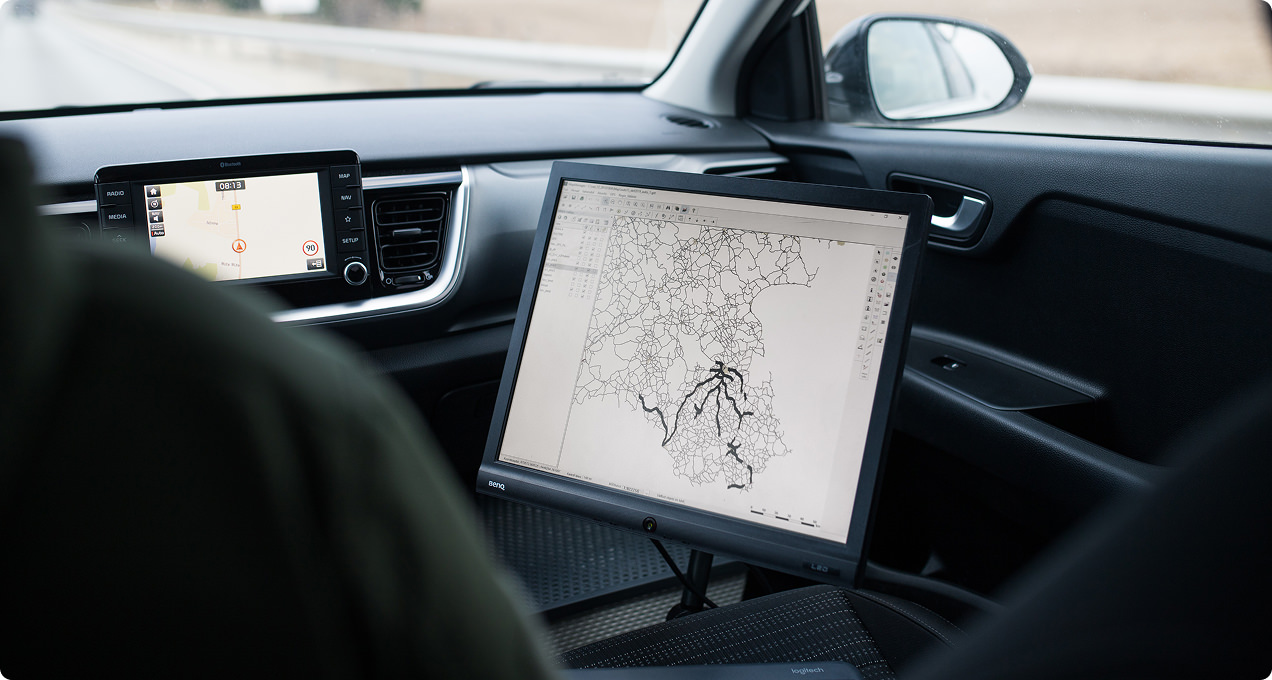
The Estonian Population Register is operated by the Ministry of the Interior and SMIT, holding personal data for citizens, EU residents, and permit holders, and serving more than 260 institutions.
Annual queries
200+ million
Connected institutions
260+
Challenge
The existing X-Road services were limited by static structures, heavy query loads, and insufficient control over how data was accessed and processed — a problem given the register’s role in critical national infrastructure.
Solution
REST-based X-Road services. Redesigned with built-in intelligent control mechanisms; queries are dynamically configurable per legal or contextual purpose.
Rule-based governance. Data managers can define which fields are accessible, under what conditions, and for which legal basis — enabling autonomous service governance.
Access-rights GUI + audit logs. A new graphical interface for managing user rights and monitoring usage in detail.
Bundled, tagged queries. Multiple queries can be bundled under a single action and tagged with legal context such as ‘justified interest’ or ‘public interest’.
AI
Backend
Java
Public
Self-Service
UX
X-road
Result
A secure, flexible, AI-ready data access platform for critical national infrastructure.
Transparent, automated, intelligent control over how population data is shared.
Stronger public-sector data governance across 260+ connected institutions.
Foundation in place for future AI-powered government services.
Key takeaway
At national-register scale, the win isn’t a faster query — it’s a governance layer that makes every query legally explicit and auditable.
KeMIT is the IT center for the Estonian Ministry of Climate, maintaining geospatial, weather, and environmental systems including KPOIS, the national land constraint information system.
AI
Backend
Java
Public
UX
Challenge
KPOIS was built on a monolithic architecture that limited flexibility, scalability, and maintenance. Manual data entry created bottlenecks, spatial analysis tools were missing, the UI was static, and integrating external data sources was painful.
Solution
Microservices migration. Transitioned KPOIS to a modular, performance-oriented architecture built for automation.
Standalone geospatial service. Introduced visual buffer-zone creation and interactive map views to support spatial decision-making.
Automated data ingestion. Replaced manual inputs with FME workflows, enabling seamless integration with external registries.
Personalized dashboard. Context-aware tasks and data presented per user, with smart session and notification management.
Schema partitioning. Restructured data models for intelligent data processing and faster queries
Result
A future-proof, automated, user-centric environment for managing land use constraints.
Faster, more accurate decisions for both end users and administrators.
Manual data flows largely replaced by automated registry integration.
Platform now ready to host AI-driven spatial analytics and predictive features.
Key takeaway
Public-sector registries don’t have to stay monolithic — microservices plus automated data flows turn a static registry into a decision-support tool.
EELIS is Estonia’s central information system for biodiversity and nature protection data, used by conservation specialists, monitoring teams, and field workers.
AI
Backend
Java
Public
UX
Challenge
EELIS was built as a monolithic, workstation-based application — the legacy architecture limited scalability, was painful to use in the field, and didn’t integrate with modern digital workflows.
Solution
Microservices migration. Complete platform rebuild on a microservices architecture for modularity and scale.
PostgreSQL geo-databases. Backed by interactive map applications and automated CI/CD deployment pipelines.
Mobile field tools. Restructured for seamless data exchange with external registries and support for mobile use in the field.
AI-ready data foundation. Reworked data models enable pattern recognition, decision support, and geospatial analytics.
Open data publishing. Opens the door to training ML models for environmental research and forecasting.
Result
An intelligent, scalable, data-rich platform for nature management across Estonia.
Specialists have meaningfully better tools for fieldwork and daily operations.
Manual data flows largely replaced by automated processes.
EELIS is now a strategic decision-support system, not just a static registry.
Key takeaway
Environmental and scientific registries gain disproportionately from microservices — the real win is unlocking AI and automation that the old architecture made impossible.
RIA, under the Ministry of Economic Affairs and Communications, develops and runs eesti.ee — the central digital gateway between the Estonian state and its citizens
Backend
Java
Public
Self-Service
Challenge
eesti.ee needed ongoing enhancements to keep users productive — but the UI lacked contextual responsiveness, and service errors often went undetected or uncommunicated outside working hours.
Solution
Real-time monitoring + event-based alerts. Automatically identifies service disruptions and notifies users and partner institutions, 24/7.
Personalized dashboards. Each citizen sees content relevant to their situation, without switching between sections.
In-article service queries. Users access relevant personal data directly inside content, in context.
Foundation for predictive error management. The alerting layer is designed to evolve from reactive to predictive.
Result
Service disruptions get detected and communicated 24/7, not just during office hours.
Users see a context-aware, personalized view of state services.
Less friction across daily interactions with the state portal.
A foundation in place to move from reactive to predictive incident handling.
Key takeaway
Citizen-facing digital services succeed or fail on small details — context-aware UI and quiet, reliable monitoring matter more than headline features.
The PPA supervises firearm licenses across Estonia, a process that historically required officials to navigate multiple systems, run time-consuming registry queries, and process paperwork manually.
AI
Backend
Java
Public
X-road
Challenge
Firearm license supervision relied on fragmented systems and manual checks across multiple interfaces, slowing decisions, increasing the risk of human error, and limiting oversight transparency.
Solution
Centralized supervision module. A single intelligent module inside the national firearm registry that handles end-to-end supervision.
X-Road registry queries. Automated queries across key government registries detect when supervision is required, with no manual lookups.
Rule-based case initiation. When triggered, the system opens the case, gathers data, compiles a structured report, and drafts a decision — without human intervention.
Built-in validation. Avoids duplicate cases and flags logical inconsistencies, further reducing error risk.
Full audit trail. A detailed data tracker monitors every registry interaction, keeping AI behavior auditable.
Result
Routine supervision tasks largely automated.
Faster, more consistent decision-making.
Reduced human error and improved data quality.
Higher transparency and accountability across oversight activities.
Key takeaway
Regulatory oversight is a natural fit for automation — but only when every AI step is auditable and a human can always inspect the trail.
Estonia’s national lottery operator, serving thousands of customers daily through both physical and digital channels under strict regulatory oversight.
Partnership
5+ years, ongoing
Paper saved each month
55 kg
Challenge
The lottery was running on Java 6 with Oracle and an aging WebLogic stack, plus a boxed third-party engine that supported only one game type. Five development teams shared one test environment, and the printers needed to read paper betslips were going end-of-life.
Solution:
Digital betslip. Customers pick numbers online, the system generates a QR code, and the ticket is validated at any physical point of sale — replacing paper-scanning hardware that was about to disappear.
AI-paired development. The team uses Windsurf, Gemini, Claude, and ChatGPT across the daily workflow; most code is AI-generated and developer-refined.
Hybrid cloud architecture.AWS tunnels bridge cloud features to existing on-premise systems, letting modernization happen without a big-bang migration.
Lightweight Scrum.Two-week sprints with weekly client check-ins keep momentum without ceremonial overhead.
AI
AWS
Backend
Java
Oracle
Public
Result
Digital betslip live — paper-ticket dependency on path to retirement.
A 3-developer team often waitingon client feedback, not the other way around.
Architecture ready for a third lottery engine to replace the existing two.
Compliance risks reduced through better monitoring and data integrity.
Key takeaway
A regulated, mission-critical legacy system can be modernized by a small AI-paired team faster than most organizations can review the output — without compromising stability or compliance.
Estonia’s independent electricity and gas transmission system operator, whose Estfeed Datahub manages 1.5 million metering points and underpins the country’s liberalized energy market.
Regression testing
10-50x faster
Metering points
1.5 million
Continuity
Zero downtime during rebuild
Challenge
Estfeed was originally built by an external firm relying on subcontractors without energy-sector expertise, leaving Elering with massive datasets, dozens of interdependent access rules, and significant technical debt — all while the platform had to keep serving millions of daily energy market transactions.
Solution
Agile, collaborative practices. Moved from quick fixes to Kanban, agile design, and requirements-driven processes; Elering’s in-house architects guide the vision, Srini executes.
AI-powered productivity. Windsurf, Gemini, NotebookLM, and ChatGPT speed up development, documentation, and translation across the team.
Custom AI testing tool. A Python-based AI testing tool that sped up regression testing by 10–50× — essential given the system’s size and complexity.
Domain-specific investment. Unlike prior subcontractors, Srini invested time in understanding energy-sector IT, so every solution fits the regulatory and operational reality.
AI
Backend
Java
Public
Self-Service
Result
Estfeed continues to support millions of energy market transactions without disruption, even mid-rebuild.
Regression cycles that used to take weeks now complete in a fraction of the time.
Elering shifted from fragmented outsourcing to a hand-in-hand in-house + Srini model.
New features and fixes ship much faster — critical in the fast-moving European energy market.
Key takeaway
Mission-critical national infrastructure can be rebuilt mid-flight — but only with domain investment, AI-paired engineering, and in-house leadership owning the vision.
Working with SRINI has been a consistently positive experience for our team at Bondora. When we first engaged them, we needed a development partner who could hit the ground running in a complex, regulated fintech environment — and SRINI delivered exactly that.
Pärtel Tomberg
CEO / Owner - Bondora
SRINI has been an essential technology partner for Modena from day one. Their team truly understands the fintech landscape and consistently delivers reliable, scalable solutions that keep our installment payment platform running smoothly. What we value most is their ownership mindset — they don't just execute tasks, they think alongside us.
Oliver Matt
CEO - Modena Estonia
SRINI helped us build the tech backbone that makes food rescue retail actually work at scale. From inventory systems to our customer-facing platform, they understood that speed and reliability aren't optional when you're dealing with perishable goods and tight margins. A partner who gets both the mission and the mechanics.
Joosep Kaljula
CEO - Sumena
Our partnership with SRINI goes beyond a typical vendor relationship. As a strategic investment and development partner, SRINI has consistently proven that they deliver on their commitments — both technically and commercially. They bring structure, transparency, and genuine expertise to every project we co-develop. It's rare to find a software company that thinks like a business partner, not just a service provider.
Kristian Hein
CEO - LEI System
How would you like to connect?
Choose your preferred way to get in touch with our team.