AI integrated innovative helpdesk

Modena Estonia OÜ is a credit and payment institution operating under a license (4.1-1/100) issued by the Estonian Financial Supervision Authority. The company provides flexible payment and financing solutions to both consumers and merchants. Modena’s product portfolio includes a “Pay in 3” zero-interest installment solution, instalment plans of up to 48 months, consumer loans, and Open Banking-based bank payments. The business is split across two portals — modena.ee (consumer-facing lending and payment services) and modena.capital (investor portal).

As a licensed financial institution, Modena operates in an environment where every customer communication, response, and escalation must be auditable, regulation-compliant, and consistently high-quality. The customer support team handles inbound emails in three languages (Estonian, English, Russian) and serves two distinct audiences with very different needs and regulatory frameworks — borrowers and investors.

Solution

  • SRINI built Modena Helpdesk — an AI-native customer support platform where artificial intelligence is not a separate “chatbot on the side” but is deeply integrated into 11 distinct business workflows. The core design principle was clear: AI gives agents superpowers, but humans always remain the final decision-makers — every AI-generated output (a reply, a category, a FAQ draft, a trend report) goes through human review before it reaches a customer or the database.
  • The platform is built on a deliberately lean and controllable tech stack — a PHP 8 monolith with a MySQL database, vanilla JavaScript on the front end, and cron jobs for background tasks — and it uses Anthropic’s Claude Messages API across three model tiers (Haiku, Sonnet, Opus). Each AI scenario uses the model that is optimal for cost-efficiency: triage and classification (high volume, simple task) run on the cheaper Haiku; reply drafting and contextual reasoning use Sonnet; Opus is reserved for the most complex cases.
  • Integration with Modena’s existing infrastructure — Microsoft 365 mail via Microsoft Graph, Azure AD SSO, and Zendesk archive sync — was delivered in a way that didn’t disrupt operations for a single day.
  • AI
  • Backend
  • PHP
  • Self-Service
  • UX
gain (5 agents): ~€27,420
Annual direct financial
€20 280 / year
Labor cost savings
Zendesk Suite + Advanced AI: ~€7 140 / year
Direct software savings vs.
~27.5h per week 12 h per month ≈ 0.7 FTE
Time saved by AI features:

Standout features

  • Per-ticket AI chat box. Every ticket has a side-panel chat where agents can talk to Claude in the context of that specific ticket. At the start of each conversation, the AI is given a dynamic context block — ticket metadata, the last 20 comments, three similar previously resolved Zendesk tickets, and portal-specific knowledge base articles. A classic RAG pattern, without a vector store.
  • Automatic email triage. Every inbound email is classified in the background: priority, category, language, a 120-character summary, and an escalation flag. Angry customers automatically rise to the top of the queue.
  • AI-generated reply drafts. The agent clicks “Generate reply” and gets a complete email draft in the customer’s language, in the right tone, grounded in Modena’s knowledge base. The draft is never sent automatically — the agent reviews and sends it.
  • 🧙 Personal prompt wizard. Each agent goes through a 5–7 question conversation, after which the AI builds them a personalized response prompt — asking about their role, areas of responsibility, tone, favorite phrases, and words to avoid. Users don’t need to learn “prompt engineering.”
  • Similar tickets RAG. From the Zendesk archive of resolved tickets, the system surfaces the three most similar cases for every new query and feeds them as context. The AI gets to see how a human handled the same kind of question before.
  • Portal-specific knowledge base. Every KB article is tagged with a portal (modena.ee OR modena.capital) — an investor ticket never sees a lending FAQ and vice versa. This solves the classic AI failure mode of “saying correct things, but for the wrong context.”
  • Weekly trend analysis. Every Monday morning, Claude emails the admin team a summary of patterns from the past seven days — recurring issues, escalated topics, possible technical glitches. Operational intelligence without an analyst on payroll.
  • Self-extending knowledge base. On Sunday evenings, Claude reviews comments from resolved tickets and drafts the three most frequently recurring FAQs. The admin gets a notification and clicks “publish” after review. The KB grows automatically based on what agents are actually answering.
  • Cost-aware model selection. Admins can see and override the model used in each AI scenario through the UI. Defaults are set per use case — this is a genuinely dollar-cost-aware AI architecture.
  • Audit transparency. Every AI action is logged: who, when, what context, what result. Mandatory in financial services, useful everywhere else.
  • Graceful degradation. If the Claude API is down, the platform keeps running without it — categories stay empty, triage returns defaults, agents reply manually. AI is an enhancement, not a critical path

Results

Based on a conservative scenario (a 5-person support team handling ~80 emails and ~50 tickets per day):

– Quality improvements that are measurable but not converted to euros:

– Response time dropped from 5–10 minutes to 1–2 minutes (review-and-send time)

– Escalations now reach the right person on the same day, not from the end of the queue

– Reply quality is more consistent across agents — everyone draws from the same KB and prior resolutions

– New hires can use the platform on day one without any “prompt engineering” training

Key takeaway

Modena Helpdesk shows that an AI-native support operation doesn’t require an “AI startup” budget — what it requires is careful integration into existing business workflows, a cost-conscious model strategy, and the discipline to keep humans in the loop. The result is a platform where AI is an invisible layer working everywhere on agents’ behalf, but never taking the final decision out of human hands.

The same approach is transferable to any organization that handles a meaningful volume of customer support, sales, or internal request flows — especially in regulated sectors (fintech, healthcare, public sector) where audit transparency and human oversight are mandatory.

Want a similar solution for your business? Let’s talk about how SRINI can build an AI-native platform tailored to your workflows.

[Get in touch →] rasmus@srini.ee

SRINI OÜ · Software development and IT modernization · Tallinn, Estonia


Case Study: AI-Powered Webshop and Warehouse Platform for Sumena.ee

Client overview

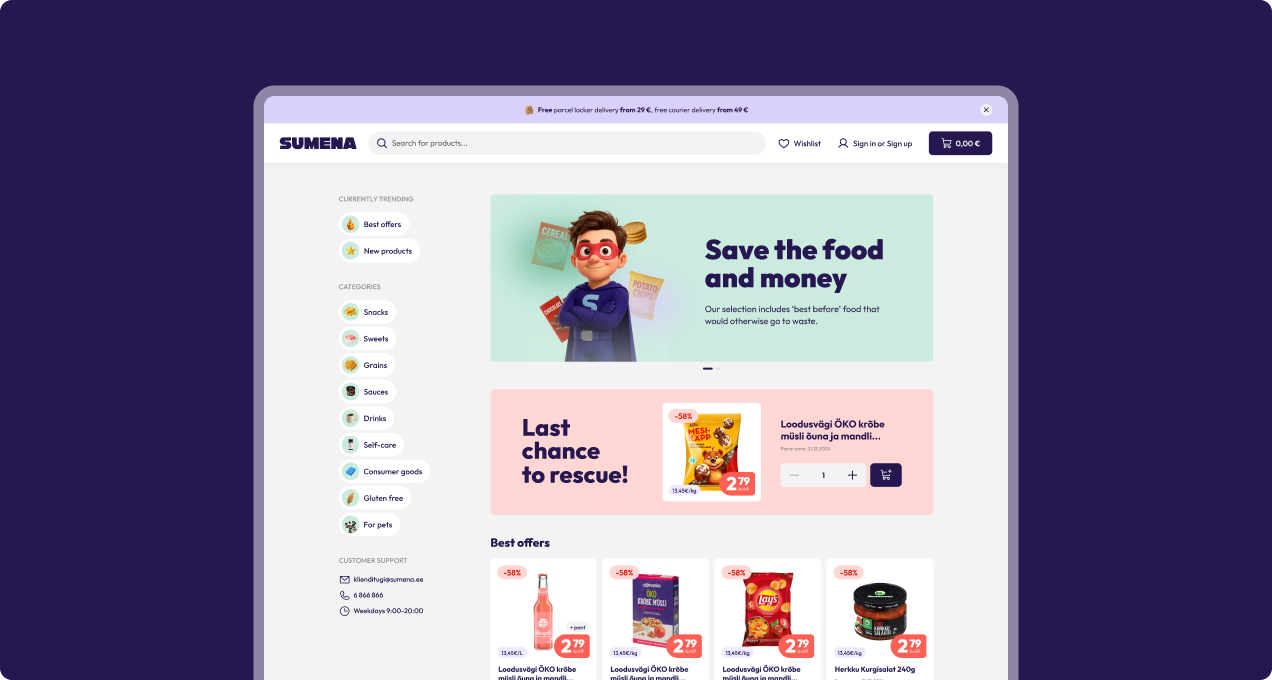
Sumena is an innovative Estonian impact-company and retail startup dedicated to reducing food waste while providing consumers with significantly discounted groceries.

Sumena’s primary goal is to fight food waste. They purchase high-quality products from manufacturers and wholesalers that are nearing their “Best Before” date, have damaged packaging, or are being discontinued. By selling these items at 30–80% discounts, they prevent perfectly edible food from ending up in landfills.

Beside e-shop they have 6 physical shops in Estonia.

  • AI
  • Backend
  • PHP
  • Self-Service
  • UX

Problem:

  • Sumena.ee needed a modern e-commerce solution that could keep up with growing customer demands
  • Manage warehouse operations efficiently, and optimize product sourcing

The manual approach to customer support, pricing decisions, and stock planning created inefficiencies, delayed responses, and missed sales opportunities due to inaccurate demand forecasting.

Solution:

  • SRINI developed a comprehensive AI-enhanced platform for Sumena.ee, integrating a responsive webshop, an intelligent sourcing module, and a warehouse management system.
  • The webshop was equipped with an AI-driven chatbot for 24/7 customer support, capable of understanding user queries and guiding purchases. Machine learning models were implemented to analyze browsing and purchase data, enabling smart predictions about product popularity and optimal pricing strategies.
  • The platform also uses AI to forecast future stock needs and estimate sourcing costs based on seasonality, trends, and supplier behavior.

Result:

  • The platform streamlined financial operations, and with added AI tools, could improve approval accuracy, customer satisfaction, and risk mitigation over time.
After rebranding and new webshop the traffic increased
2x
Revenue increased
2x MoM

Case studies

What Clients say

Working with SRINI has been a consistently positive experience for our team at Bondora. When we first engaged them, we needed a development partner who could hit the ground running in a complex, regulated fintech environment — and SRINI delivered exactly that.

SRINI has been an essential technology partner for Modena from day one. Their team truly understands the fintech landscape and consistently delivers reliable, scalable solutions that keep our installment payment platform running smoothly. What we value most is their ownership mindset — they don't just execute tasks, they think alongside us.

SRINI helped us build the tech backbone that makes food rescue retail actually work at scale. From inventory systems to our customer-facing platform, they understood that speed and reliability aren't optional when you're dealing with perishable goods and tight margins. A partner who gets both the mission and the mechanics.

Our partnership with SRINI goes beyond a typical vendor relationship. As a strategic investment and development partner, SRINI has consistently proven that they deliver on their commitments — both technically and commercially. They bring structure, transparency, and genuine expertise to every project we co-develop. It's rare to find a software company that thinks like a business partner, not just a service provider.